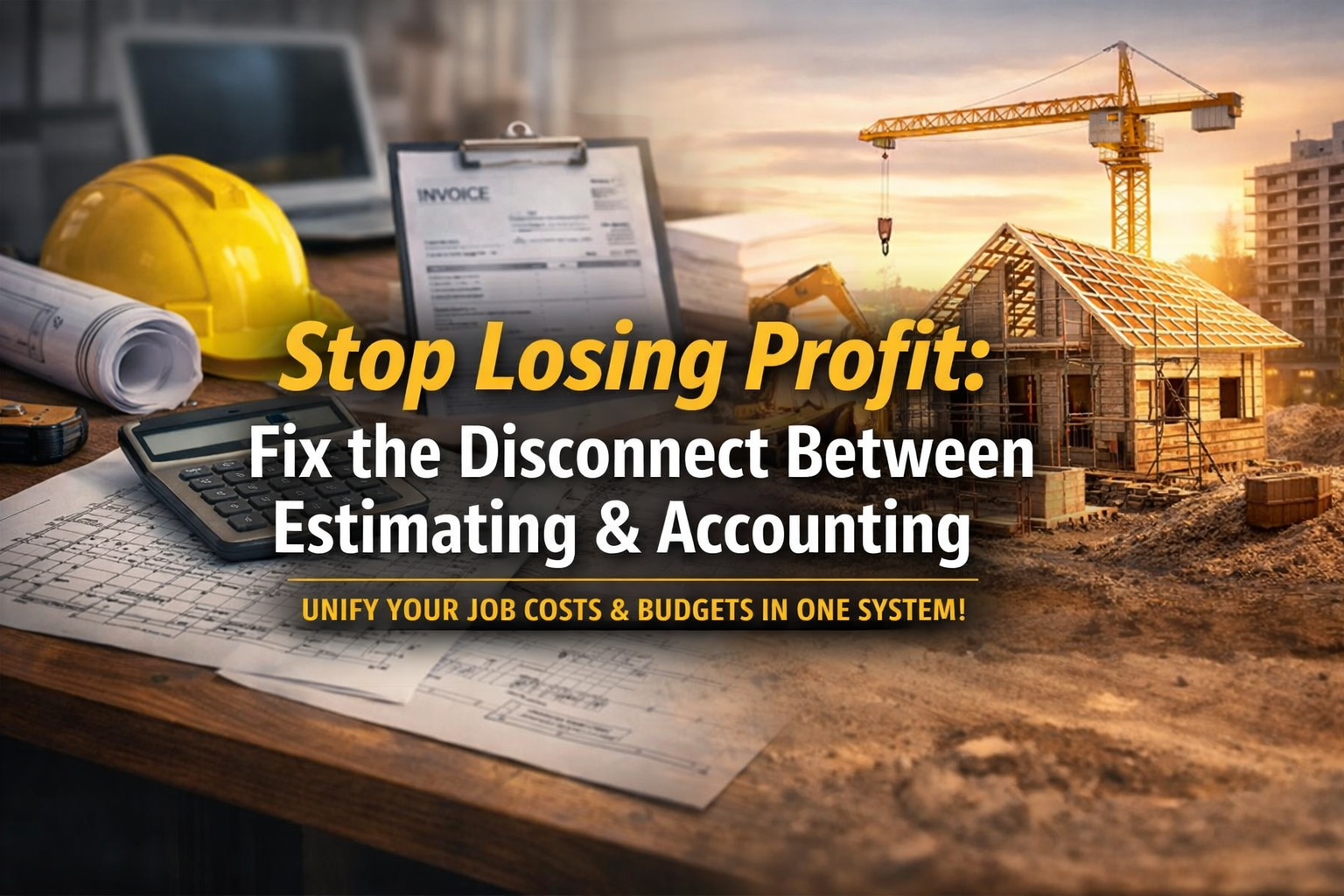
The Hidden Profit Killer in Small Construction Companies: The Disconnect Between Estimating and Accounting
In many small building companies estimating and the accounting software are not connected. The estimating process lives in one world and the accounting process lives in another. The owner or estimator builds budgets in a spreadsheet or a third‑party estimating tool, while the accounting department handles invoices, job costing, and financial reporting in a completely separate system.
On the surface, this seems harmless. In reality, it creates one of the biggest operational and financial risks in residential construction: two systems that don’t talk to each other.
This disconnect leads to inaccurate job costs, delayed decisions, missed overruns, and lost profit — and most builders don’t even realize it’s happening until the damage is done. In addition it leaves no room for growth and control.
Let’s break down why this workflow is so common, why it’s so dangerous, and how integrating estimating with job cost accounting solves the problem.
How Most Small Builders Operate Today
A typical small building company follows this pattern:
1. The Owner or Estimator Builds the Budget
They use:
- A spreadsheet
- A standalone estimating app
- Or a mix of both
They create budgets by category of work — framing, concrete, roofing, electrical, etc.
2. Invoices Arrive Throughout the Job
The owner manually compares each invoice to the estimate to see:
- Does this cost fit the budget
- Is it coded to the right category
- Is it expected or unexpected
3. The Owner Hands the Invoice to Accounting
Accounting then:
- Enters the invoice
- Pays the vendor
- Assigns job cost codes
- Updates financials and reports
This workflow depends entirely on the owner acting as the “bridge” between estimating and accounting.
And that’s where the trouble begins.
Why This Creates Serious Problems for Builders
1. Two Systems = Two Versions of the Truth
The estimate lives in one system. The job costs live in another.
Because they don’t sync:
- Accounting never sees the full estimate
- Estimating never sees the real costs
- The owner becomes the only person who “knows” the job’s financial picture
This creates blind spots everywhere.
2. The Owner Becomes the Bottleneck
Every invoice, every cost, every decision must pass through the owner.
This leads to:
- Delayed payments
- Delayed job costing
- Delayed reporting
- Delayed decisions
And when the owner is busy (which is always), mistakes slip through.
3. Manual Comparison = Guaranteed Errors
When the estimate isn’t inside the accounting system, every invoice must be manually checked.
That means:
- Wrong cost codes
- Missed invoices
- Incorrect budget comparisons
- Overruns that go unnoticed
One small mistake early in the job can snowball into a major loss by the end.
4. Accounting Is Flying Blind
The accounting department is responsible for:
- Job costing
- WIP reporting
- Vendor payments
- Progress billing
- Financial statements
But without the estimate in their system, they’re guessing.
They don’t know:
- What the budget was
- Whether a cost is over or under
- Whether a change order was included
- Whether a vendor invoice is legitimate
They’re entering numbers without context — and the reports they produce reflect that.
5. No Real-Time Visibility Into Profitability
Disconnected systems mean:
- The estimate is static
- The accounting data is reactive
- No one sees the true financial status of the job until it’s too late
By the time overruns show up in the accounting system, the job is already in trouble.
Builders end up asking:
- “Where did the money go”
- “Why didn’t we catch this earlier”
- “Why is this job losing margin”
The answer is always the same: the systems weren’t integrated.
6. Change Orders Become a Mess
When change orders are estimated in one system and accounted for in another:
- Revised budgets don’t flow to accounting
- Contract amounts don’t update
- Committed costs don’t update
- Billing becomes inconsistent
- Revenue gets missed
This is one of the biggest sources of lost profit in small construction companies.
7. Double Entry = Double the Work (and Double the Risk)
Every job setup, budget, PO, subcontract, and change order must be entered twice:
- Once in estimating
- Once in accounting
This creates:
- More admin work
- More errors
- More confusion
- More finger‑pointing
And it’s completely avoidable.
The Core Problem
This isn’t a people problem. It’s not an accounting problem. It’s not an estimating problem.
It’s a system problem.
When estimating and accounting don’t share data, the entire company runs on disconnected information — and the owner becomes the only person holding it together.
That’s not scalable. It’s not efficient. And it’s not profitable.
The Solution: Integrate Estimating With Job Cost Accounting
When estimating and accounting operate in one integrated system:
1. The Estimate Automatically Becomes the Job Budget
No re-entry. No errors. No delays.
2. Accounting Sees the Full Financial Blueprint
They know exactly what the job was supposed to cost.
3. Actual Costs Update Against the Estimate in Real Time
Overruns are caught early — not after the job is finished.
4. Change Orders Flow Through the Entire System
Budgets, contract amounts, and billing stay accurate.
5. The Owner Is No Longer the Bottleneck
The system handles the communication automatically.
6. Everyone Works From One Version of the Truth
Estimating, accounting, project management, and ownership all see the same numbers.
This is how profitable builders operate.
Final Takeaway
If your estimating and accounting systems don’t talk to each other, you’re running your business with blind spots. You’re relying on manual comparisons, duplicated work, and outdated information — and that’s a recipe for lost profit.
Integrating estimating with job cost accounting isn’t just a software upgrade. It’s a business transformation.
It gives you clarity. It gives your team alignment. And it gives your company the financial control it needs to grow.
Contractors Software Group offers integrated estimating and job cost accounting for more information go to www.csgsoftware.com
You can also check out this blog: https://contractorssoftwaregroup.com/why-bookkeepers-and-accountants-are-undervalued-in-construction/