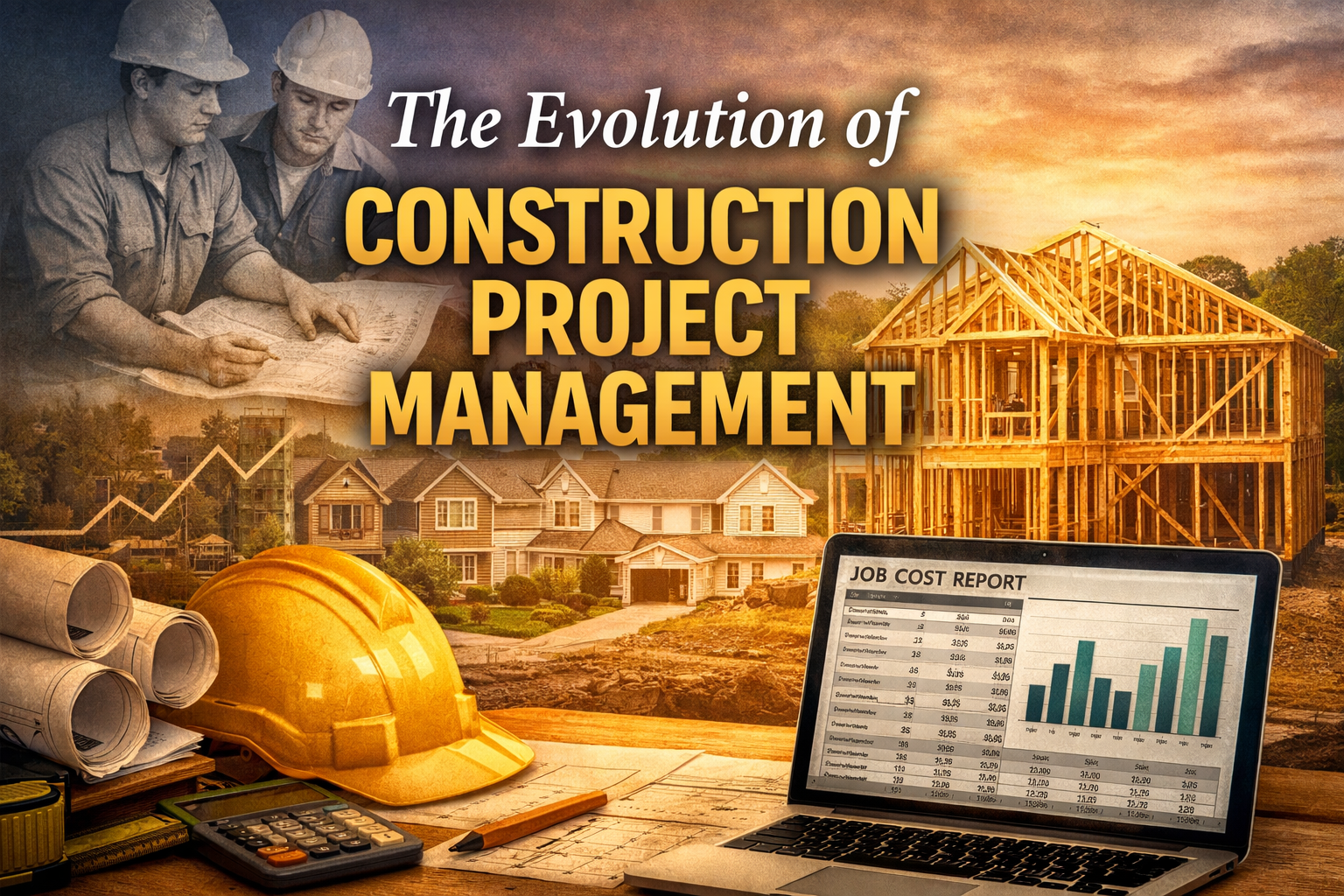
The Evolution of Construction Project Management: Why Job Cost Accounting Still Defines Success
Since the beginning of my career in the construction software industry—more than forty years ago—the most successful construction companies have always managed their projects through some form of true job costing. They tracked actual costs against revised budgets by category of work to catch overruns early and to improve the accuracy of their estimating. This same analysis helped them prevent vendors from double billing or overcharging for labor, materials, or deliveries. They also monitored actual versus budgeted labor hours to sharpen their estimating for future jobs.
But for many owners & project managers, the process of comparing vendor invoices and employee time against budgeted costs and hours was tedious and time‑consuming. That’s when the industry split. Some owners moved to generic accounting programs like QuickBooks, hoping to simplify the workload. Others invested in construction‑specific job cost accounting systems designed to manage jobs the right way.
The original thinking was simple: estimators would hand off their job budgets to the bookkeepers, and the accounting department would take it from there—job costing, bill paying, billing, payroll, bookkeeping, and financial reporting. Owners believed this setup would streamline project management and lighten the accounting workload. For a while, it looked like a win for both estimating and accounting.
But as time went on, the construction companies that switched to generic accounting programs like QuickBooks discovered a hard truth: tracking actual costs against revised budgets falls apart the moment change orders start moving the target. Without continuously updated budgets, they quickly realized they couldn’t produce accurate work‑in‑process (WIP) reports—making their financial statements unreliable and nearly impossible to use for managing the business.
Instead of investing in a construction‑specific job cost accounting system, many stayed with QuickBooks and fell back on manual methods or Excel to analyze job costs. That created the same extra work for owners and project managers, just in a different format.
And the result is predictable: most owners only look at their financial statements once a year because, without WIP reporting, those statements don’t tell them anything meaningful about job profitability or the true financial health of the company.
A few years later, third‑party project management systems came on the scene claiming they “did job costing” and “integrated with QuickBooks.” On the surface, it sounded like the perfect workaround—another tool to help owners and project managers manage jobs more easily without switching accounting systems.
But the problem was simple: nobody read the fine print on what “integration” actually meant. And once companies started using these systems, the cracks showed fast.
The construction companies that invested in a true, construction‑specific job cost accounting system decades ago are still using those systems today—some for more than 40 years. There’s a reason for that longevity: the job costing is accurate, accountable, and owned by the accounting department, not scattered across spreadsheets or third‑party apps.
Because these systems maintain revised budgets, track actuals correctly, and produce reliable work‑in‑process (WIP) reports, the financial statements become powerful tools for running the business—not just paperwork for the bank or the CPA.
In short, the companies that chose construction‑specific job cost accounting systems decades ago are still using them because they work—and they continue to give owners the clarity, control, and confidence they need to run a successful construction business.
Contractors Software Group develops three series of construction specific job cost accounting systems for residential and light commercial construction companies based upon size, needs and budget. For more information go to: https://contractorssoftwaregroup.com/job-cost-accounting-software/
Contractors Software Group also develops estimating system that integrates to job cost accounting so estimating and accounting department are connected. Here is a blog on why your estimating system should integrate to your job cost accounting system. https://contractorssoftwaregroup.com/integrated-estimating-job-cost-accounting-for-builders/