
What Contractors Are Getting Right—and Wrong About AI Estimating systems
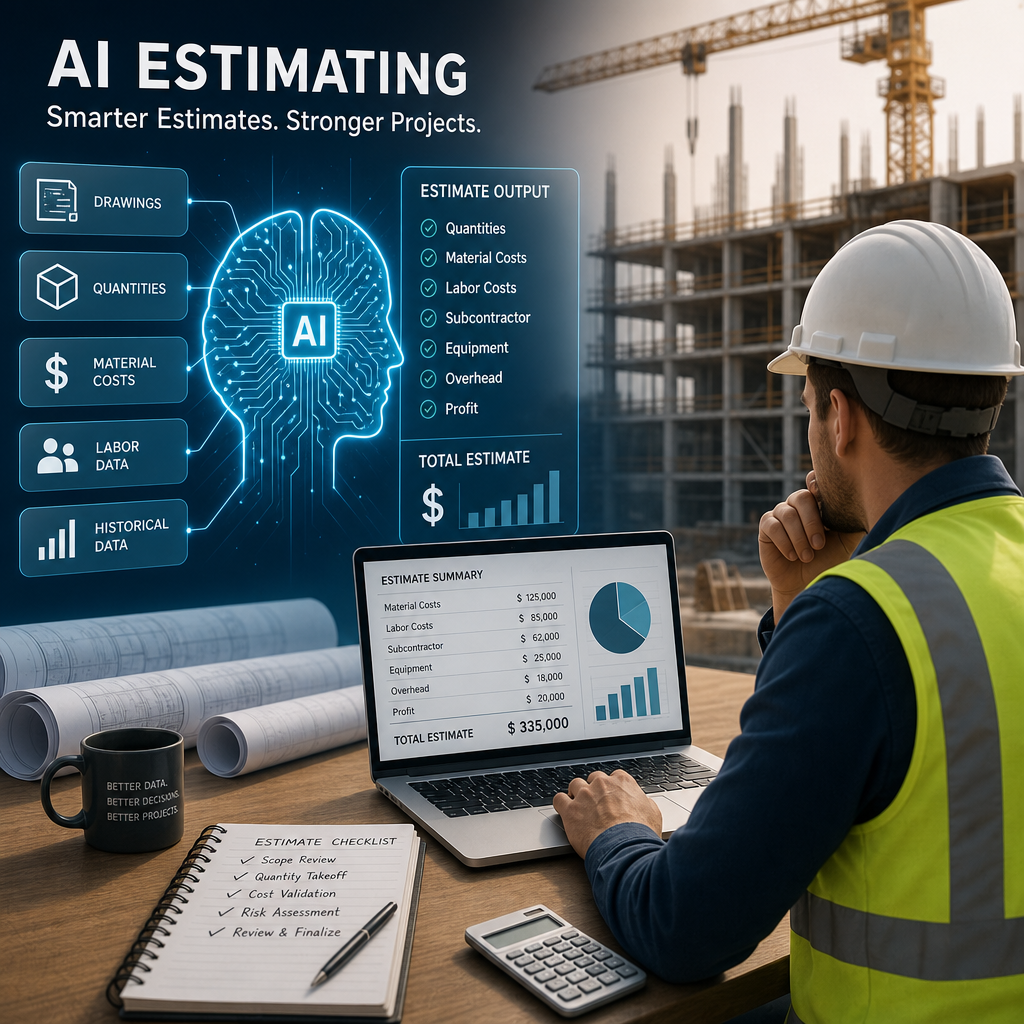
AI for estimating is the hot topic across the construction industry right now. Everywhere you look, contractors are experimenting with AI tools—especially for taking off footages and counts from digital blueprints. The appeal is obvious: speed, automation, and the promise of getting more done with fewer people.
But speed isn’t the same as accuracy, and that’s where the story gets interesting.
Why Newer Contractors Are Leaning on AI
Many newer construction companies are using AI not just for takeoffs, but to generate entire estimates and proposals. For them, it feels like a shortcut. They don’t yet have:
- Established estimating systems
- Proven material and labor cost structures
- Vendor pricing relationships
- Historical job cost data
So AI seems like a fast way to fill in the gaps.
And yes—AI can generate an estimate or proposal quickly. But “quick” doesn’t mean “correct.”
AI only produces accurate results when the user knows exactly what to ask and where the data should come from. Blueprints rarely contain every cost required to complete a project. Labor factors vary widely. Vendor pricing changes constantly. If a contractor doesn’t know these inputs, the AI won’t magically supply them.
What many are discovering is simple: AI can speed up estimating, but it cannot replace the foundational knowledge required to estimate accurately.
Why Established Contractors Aren’t Rushing to Replace Their Systems
On the other side of the spectrum, established construction companies are finding it hard to justify switching to AI‑only estimating tools—and for good reason.
They’ve already spent years refining their estimating process using construction‑specific job cost accounting systems. They’ve built tight feedback loops between:
- Actual vs. budgeted cost analysis
- Vendor pricing
- Labor productivity
- Historical job performance
Their estimating systems already generate budgets, material lists, purchase orders, subcontracts, and work orders in seconds. Many also use the same system to estimate, track, and generate change orders—along with all the budgets and documents tied to those changes.
And because their estimating system is integrated with job cost accounting, CRM, scheduling, and builder portals, communication between departments is seamless.
So the question becomes: How much time would an AI‑only estimating tool actually save them? For most established contractors, the answer is: not much.
A Warning for New Contractors Relying Solely on AI
Coming from the last generation of builders and contractors, here’s my biggest recommendation to newer companies jumping into AI estimating:
Invest in a construction‑specific job cost accounting system and start doing actual vs. budgeted cost analysis.
If you don’t, you may not realize where your money is actually coming from. Many new contractors unknowingly fund current jobs with down payments from future jobs. When the pipeline slows down, they suddenly discover that the money in their bank account isn’t profit—it belongs to vendors, employees, or worse, the government.
Without a handle on job costs and financials, the business becomes unstable. And when the market tightens, companies without solid job cost accounting don’t just struggle—they disappear.
AI won’t fix that.
Where Contractors Software Group Fits In
Contractors Software Group develops three series of job cost accounting systems, along with three series of estimating, scheduling, and CRM software. Our Professional Series has available CSG Central, a builder portal that improves communication with employees, vendors, and clients.
If you’re exploring AI estimating—or trying to strengthen the systems you already have—start with the foundation that keeps builders and contractors profitable: integrated job cost accounting.
Blog on:The Evolution of Construction Project Management: Why Job Cost Accounting Still Defines Success: https://contractorssoftwaregroup.com/the-evolution-of-construction-project-management/
Learn more at www.csgsoftware.com